

What Is Jaundice and Why Does It Happen?

How to Identify Jaundice
- Look at their face under natural, bright light.
- Gently press a finger on their skin and notice the color change.
- Check how far the yellowing extends down their body.
- If the yellowing is limited to the face, it’s usually mild and should resolve on its own within a few weeks.
- If the yellowing spreads to the chest, abdomen, or legs — or if your baby’s eyes appear very yellow — consult a doctor.
Why Does Jaundice Matter?

Signs to Watch For:
- Changes in behavior: Your baby seems unusually sleepy, sluggish, floppy, or difficult to wake.
- Feeding issues: Trouble latching, refusing to eat, or eating significantly less than usual.
- Two missed feeds in a row: If your baby misses two consecutive feedings or is too sleepy to wake and eat, contact your pediatrician.
- Worsening yellowing: If jaundice spreads beyond the face to the chest, belly, arms, or legs, or if the whites of their eyes appear deep yellow.
- High-pitched crying: A shrill or abnormal cry could indicate rising bilirubin levels affecting the brain.
- Arched back or stiffness: Babies with severe jaundice may arch their backs, become rigid, or display unusual postures.
Risk Factors
Certain conditions can increase the likelihood of jaundice becoming more severe:
- Prematurity: Babies born before 37 weeks may take longer to process bilirubin since their livers are still developing.
- Breastfeeding challenges: Limited milk intake in the first few days (breastfeeding jaundice) or natural substances in breast milk that slow bilirubin breakdown (breast milk jaundice) can increase bilirubin levels.
- Blood type incompatibility: If a baby’s blood type is incompatible with the mother’s (such as Rh or ABO incompatibility), their red blood cells may break down more quickly, leading to higher bilirubin levels.
- Bruising or cephalohematoma: Babies with significant bruising at birth or a cephalohematoma are at higher risk because bruised red blood cells break down and release extra bilirubin.
What Tests Are Done?
How Is Jaundice Treated?
- At-home care: filtered sunlight through a window for 10–20 minutes at a time, several times a day.
Moderate cases:
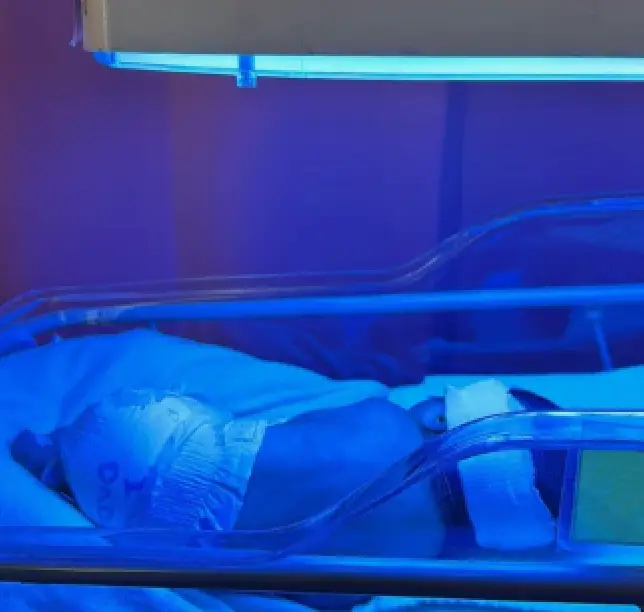
- Phototherapy (usually in hospital): blue light lowers bilirubin levels. Baby lies under the light with eye protection.
Severe cases:
- Hydration therapy (in hospital).
- Exchange transfusion in extreme cases.
The Wrap-Up
FAQ: What Parents Are Asking About Jaundice
❓ Is jaundice common in newborns? Yes, about 6 out of 10 full-term newborns develop some degree of jaundice, and it is even more common in premature babies.
❓ How long does jaundice usually last? In formula-fed babies, most jaundice goes away within 2 weeks. In breastfed babies, it is common for it to last 3 weeks or even up to a month.
❓ Can I treat jaundice by putting my baby in the sun? No, the AAP does not recommend putting your baby in direct sunlight as a safe way to treat jaundice due to the risk of sunburn and overheating.
❓ Why do breastfed babies have a higher risk of jaundice? This often happens if a baby is not getting enough milk in the first few days, which slows down bowel movements and allows bilirubin to stay in the system longer.
❓ What is phototherapy? Phototherapy is a treatment where the baby is placed under special blue-green lights that help break down bilirubin so the body can remove it more easily.
❓ Will my baby need to stay in the hospital for jaundice? Most babies with mild jaundice do not need hospital treatment. If levels are high, they may need 24 to 48 hours of light therapy, which can sometimes even be done at home.
❓ Does jaundice cause permanent damage? In the vast majority of cases, no. Jaundice is treated at levels much lower than those that cause concern for brain damage.
❓ Should I stop breastfeeding if my baby is jaundiced? No, you should continue to breastfeed. Frequent nursing is actually one of the best ways to help lower bilirubin levels.